From South African Roots to Global Clivia Leadership
Our Story
The Clivia Society began with a shared passion for a remarkable plant — the Clivia, native to southern Africa and celebrated for its vivid blooms, resilience, and botanical elegance. What started as a handful of enthusiasts exchanging ideas has grown into a worldwide network of growers, researchers, and collectors dedicated to the conservation, cultivation, and celebration of this iconic genus.
Humble Beginnings
The origins of the Clivia Society trace back to 1992, when Nick Primich from Johannesburg began publishing a modest newsletter to connect Clivia lovers across the globe. His vision was simple but far-reaching: to encourage the exchange of pollen, seed, and knowledge to build stronger, healthier Clivia collections worldwide.
That first newsletter brought together 25 founding members - 16 from South Africa, 5 from Australia, 2 from the USA, and one each from Hong Kong and Japan. These early exchanges laid the foundation for what would become a vibrant international community.
By January 1994, the enthusiasm had grown enough to formalise the group. On the 22nd of January, at the home of James and Connie Abel in Pretoria, the Clivia Club was officially formed. With James Abel elected as the first chairman, the club quickly developed activities that would become central to the Society’s mission: member meetings, garden visits, shows, conferences, photographic exhibitions, and habitat tours.
Growth and Momentum
The first Clivia Conference and Show took place on 17 September 1994 at the National Botanical Gardens in Pretoria. The event exceeded all expectations — featuring international speakers such as Yoshikazu Nakamura (Japan), Keith Hammett (New Zealand), and Pen Henry (Australia). This marked the beginning of a tradition that continues to unite Clivia enthusiasts from around the world.
In the years that followed, James and Connie Abel played a central role in growing the Club, hosting meetings and organising tours to Clivia habitats like God’s Window to observe species such as Clivia caulescens in their natural setting. The Club also encouraged new branches to form - beginning with the KwaZulu-Natal Clivia Club in 1995, followed soon after by the Cape Clivia Club under John Winter at Kirstenbosch Botanical Gardens.
From Clivia Club to Clivia Society
As membership expanded, it became clear that the Clivia Club needed a new structure. In 2001, after extensive discussion and consultation, a new constitution was adopted, and the organisation was renamed the Clivia Society.
The Society transitioned from a single, centralised body into an umbrella organisation supporting independent regional clubs around the world - a model that encouraged growth while maintaining unity of purpose. This evolution ensured that Clivia enthusiasts everywhere could belong to a local club while sharing in the global network of the Society.
By 2003, the Clivia Society had around 1,300 members, with thirteen shows held across South Africa and exhibitions in New Zealand and Australia - proof of its thriving international reach.
Growing Into a Global Society
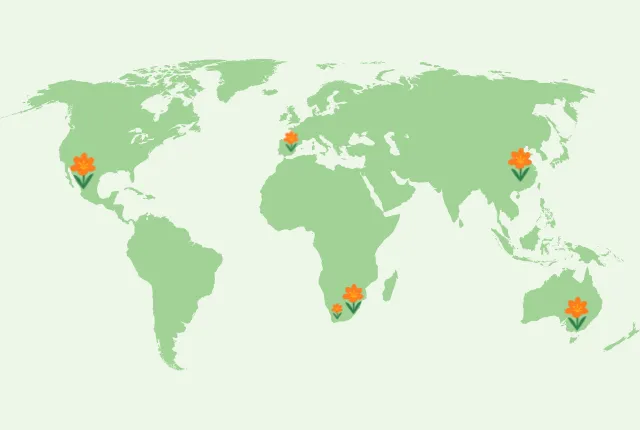
What began as a local South African initiative soon gained international momentum. Over the decades, the Society has expanded to include affiliated clubs and members in:
Australia
The United Kingdom
The United States
Europe
New Zealand
And many more regions
This growth has created a worldwide network of Clivia enthusiasts - connected by passion, tradition, and plant expertise.
Major milestones include:
- Publishing Clivia News and annual yearbooks
- Establishing the official Clivia Register to document cultivars
- Hosting national and international Clivia shows, judging events, and international conferences
- Supporting conservation projects and habitat preservation
More Than a Plant Society
The Clivia Society is more than just an organisation — it's a vibrant, multi-generational community united by a love for nature, biodiversity, and horticultural excellence.
Nurturing Growers
Through mentorship, collaboration, and shared curiosity, the Society has helped new growers become lifelong stewards of the Clivia genus. Members contribute original research, hybridise new cultivars, and actively support the conservation of wild species.
Celebrating Stories
From seedling to showcase, every Clivia has a story — and so does every member. The Society celebrates both plant and person, encouraging participation at every level.
Looking to the Future
As the Clivia Society continues to grow, we remain committed to:
Preserving wild Clivia populations
Expanding educational resources
Supporting regional clubs and new members
Encouraging innovation in breeding and conservation
Whether you're just beginning your Clivia journey or have decades of experience, you're invited to be part of our next chapter.